What this specifies
VMK Defense is an electro-optical air-defense system. This document specifies how a new threat enters the tracker, how one optical head produces a position accurate enough to shoot, and how further heads extend that into a volume wide enough for a city.
Three decisions carry it:
- The simulation is the training range. A new airframe is learned before it is common in the sky, and the same weights load onto every detector.
- One head is a firing position. Azimuth, elevation, and stereo range from that head are enough to shoot. Further heads are added only to hold a three-dimensional picture over a very wide area.
- Autofire chooses the moment of the burst. The system holds a fire solution on a slant of 2–3 km and releases the burst at 1,800 m.
The workstation today runs the loop on one simulated head: pixel tracking, a retrained detector, and autofire on one effector. The sections below specify the field system that head is built to join.
Training the tracker on a new threat
Airframes change faster than sites do. A detector trained on last year's pictures still sees the sky, and it is slow to name a new shape. Waiting for a library of real intercepts leaves the first engagements half-blind. The simulation is the path that does not wait.
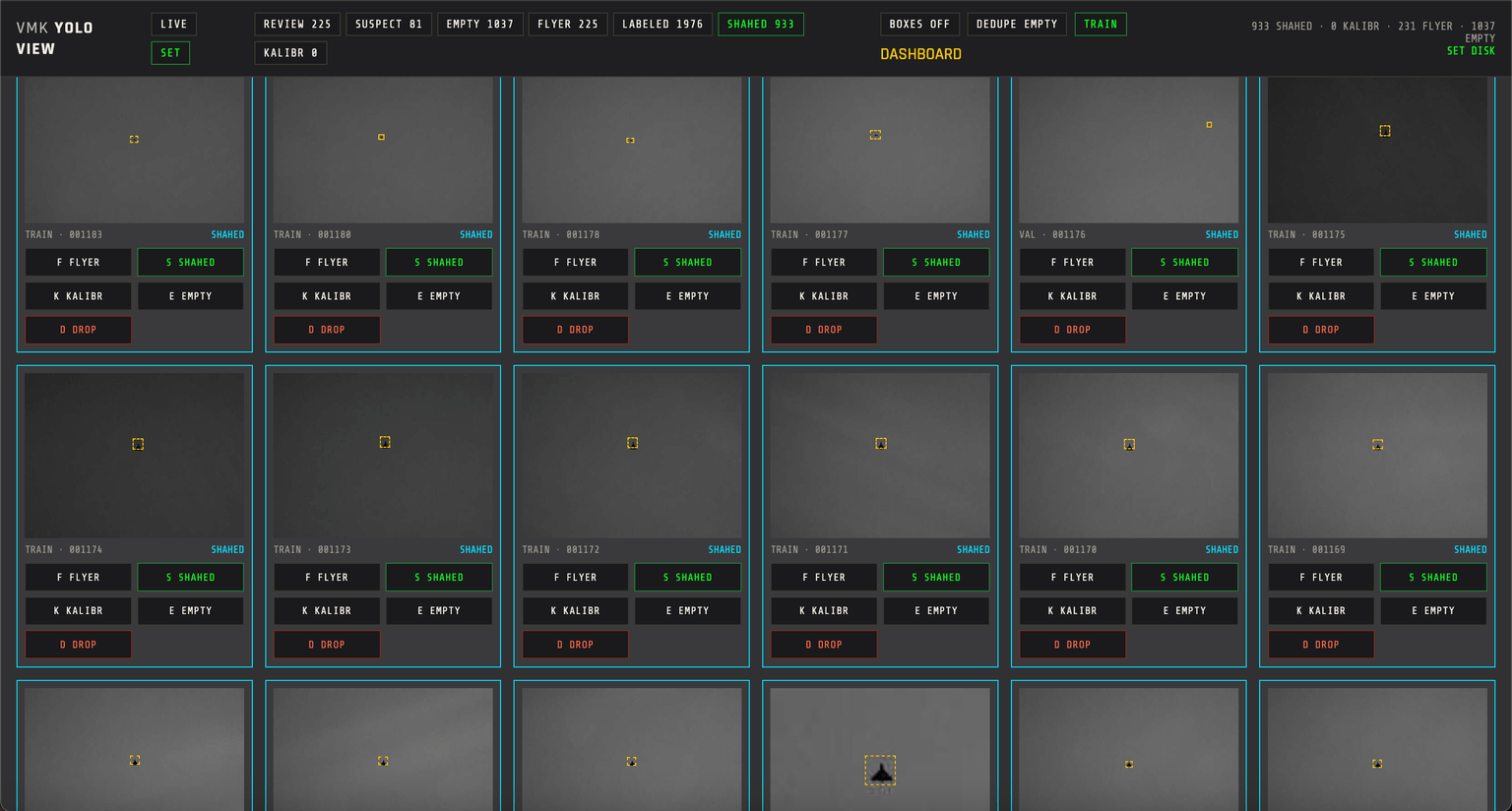 The training view: synthetic near-infrared frames, labeled as they are generated, reviewed, then used to retrain the detector.
A new threat is built as a visual model and flown through the situations a site will meet: noon and night, haze and clear air, overhead passes, low crossings, head-on runs, and cluttered ground under the camera. Every frame is labeled as it is generated. The tracker that trains on those frames sees only the imagery, the same pixels a mast camera would deliver. It searches, holds, confirms a type, and rejects glare, roofs, and other still objects. It never receives the simulation's identity of the object.
The detector is fine-tuned on that set and reloaded. Old types stay in the set. False tracks from earlier sessions stay too, so the update learns the new silhouette and keeps the sky and the rooftops it already knew. The optics in the field do not change. The weights do.
Because every detector runs the same stack, a threat learned once is recognizable on every head. That is what makes a multi-head picture usable on the day a new shape appears, rather than after each mast has met it alone. The same flights also exercise the rest of the chain: the three-dimensional track, the sector the object falls in, and the autofire decision. A new flight path can be checked against the burst timing before a weight file is sent to a mast.
Detectors and effectors are separate
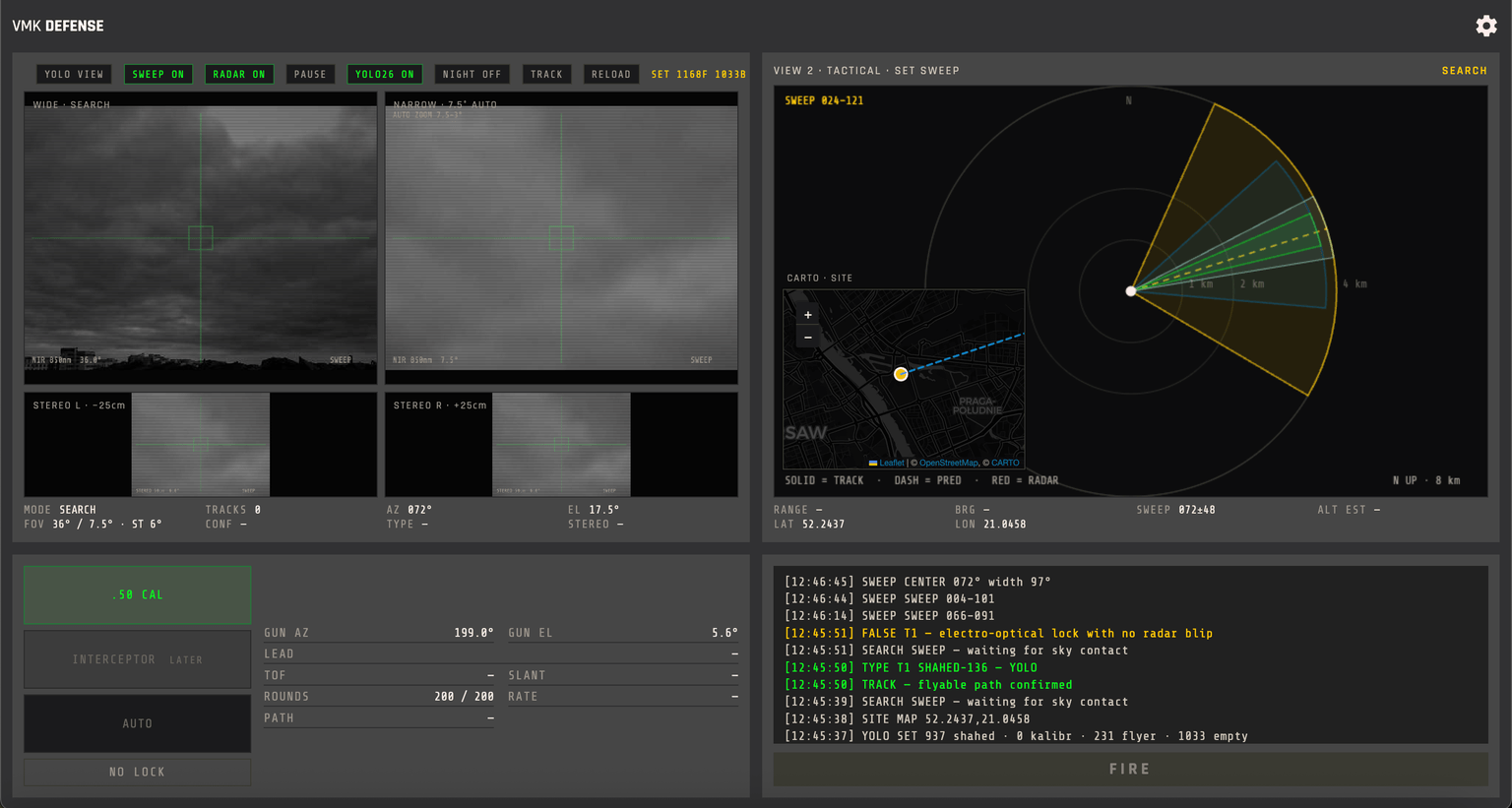 A detector in search: wide and narrow views, the stereo pair, and the sweep over its sector. With no track yet, the effector has nothing to fire on.
A detector is an optical head. It searches a sector, holds an object in a narrow view, and measures range with a stereo pair. Detection and tracking run on an edge computer beside the mast. Its product is a track.
An effector consumes a track. It points from the track's position and velocity and fires a burst. In the site configuration that effector is a .50-caliber gun. In the compact point-defense configuration it is a 5.56 mm turret. The tracker does not contain the gun, and the gun does not contain the tracker.
| Detector | Effector | |
|---|---|---|
| What it is | Optical head and edge computer | Gun, or another defeat system, plus its fire control |
| What it produces | A track: direction, range, type | A burst, timed from a track it is given |
| How it is fielded | One head is a complete firing position. More heads cover a wider volume | One per sector its slant can cover |
| What a new threat changes | The weights on the head | Nothing, until the track it receives changes |
Separating them is what makes a single position affordable to repeat. One head and one effector are enough to shoot: the head's own azimuth, elevation, and stereo range are the position the burst is fired from. Further heads are for the places one sector cannot see.
One head shoots. Many heads cover a city
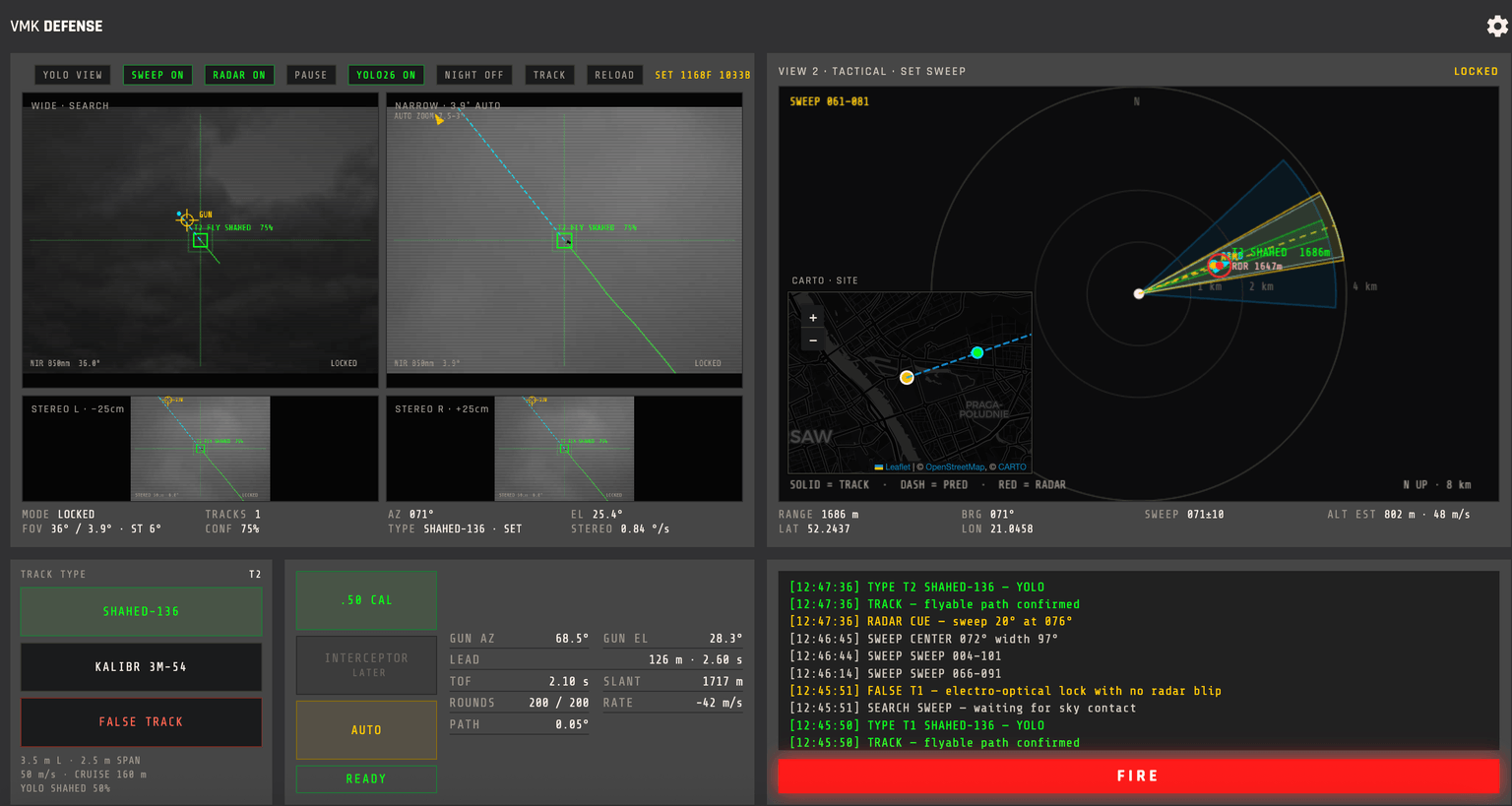 One head is a firing position: search, narrow follow, stereo range, and a sector.
A single head already holds an effective position. Search finds the object, the narrow view stays with it, and the stereo pair gives range. From that, fire control has azimuth, elevation, slant, lead, and time of flight. That is a firing solution. A second head is not required to take the shot.
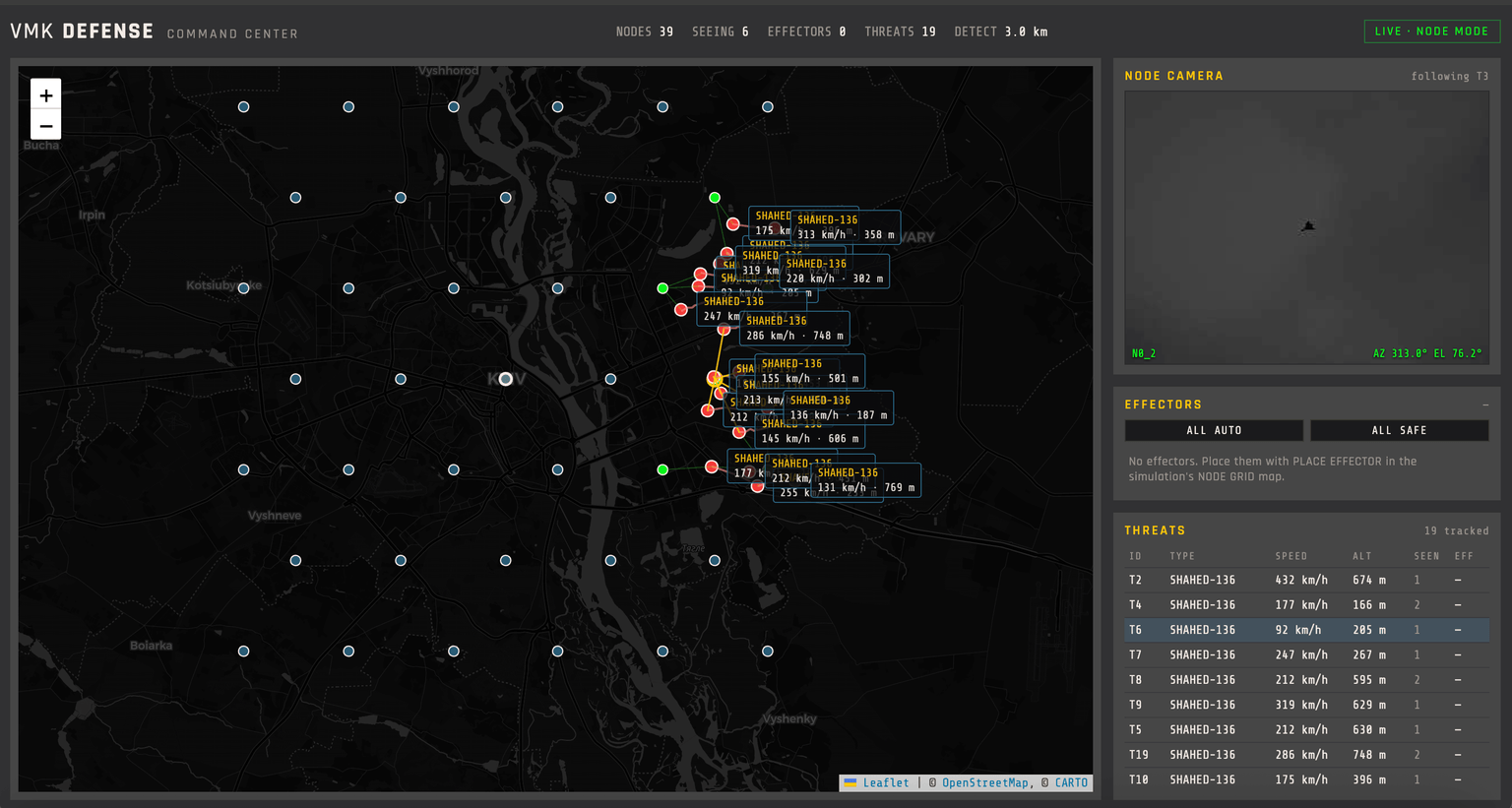 Many heads, one picture: every threat keeps its type, speed, and altitude as it crosses the volume.
Further heads are how that same solution is stretched over a very wide area. Each head still shoots from its own reading. Together they fill one three-dimensional volume: every threat in the sky over that area, each with a position, a velocity, and a type, handed from head to head as it flies. The overlap is what keeps the picture continuous across the city. It is how coverage gets wide. It is not how a single shot becomes accurate.
The preferred place for that volume is in front of the city. A belt of positions along the approaches creates a shoot-down area the drones have to cross before they arrive. The engagement happens outside the streets, at the slant autofire already uses. A grid over the city itself remains the way to cover threats that are already overhead. Stopping them on the way in is the stronger layout.
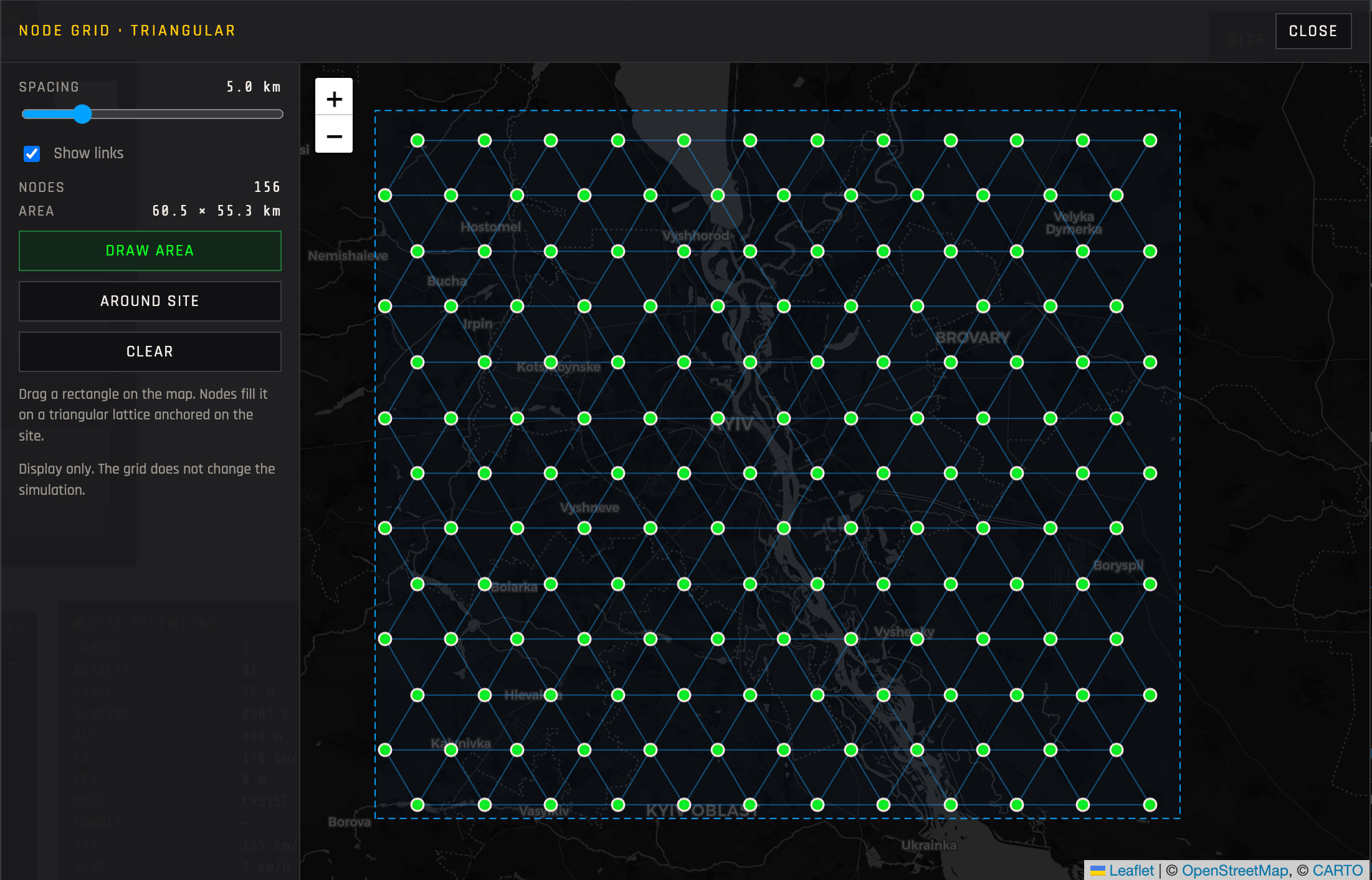 A grid over the city. Nodes fill a rectangle on a triangular lattice, here at 5 km, and each node is a firing position.
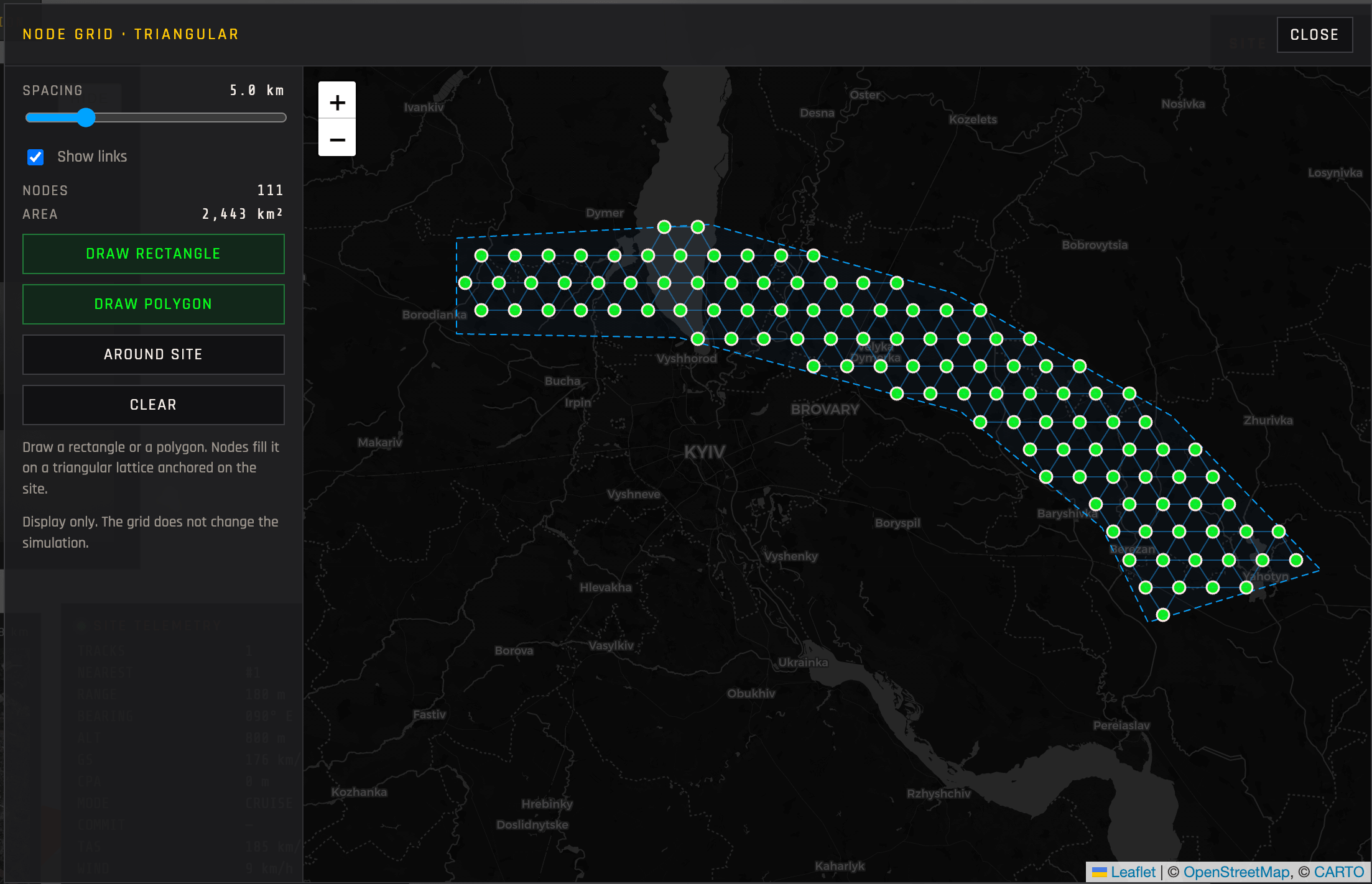 The same lattice drawn as a belt in front of the city. Drones cross this volume before they arrive.
Effectors chosen by sector
The defended volume is divided into sectors. A threat's position in the three-dimensional picture places it in one of them, and that sector names the effector responsible for it.
The track itself stays effector-agnostic. Position, velocity, and type move with the object. When the object crosses from one sector into another, fire control on the effector that owns the new sector takes the same state. The tracker is not restarted, and the heads keep contributing.
Different sectors can carry different effectors, matched to the threat that flies there:
- A close sector, such as a vehicle, a trench line, or a piece of equipment, can take the compact 5.56 mm turret. That round suits a small, fragile airframe, and the unit can run automatically inside a zone the operator has set.
- A site sector against one-way attack drones and jet-powered drones can take the .50-caliber effector.
- A sector whose geometry or threat class calls for a heavier effector can take one, on the same track, with its own fire-control limits.
Effectors stay sparse because each one covers the sectors its slant reaches. Detectors fill the looks between them. The density of the picture and the density of the guns are chosen separately.
What an effector costs, and a city grid
A purpose-built effector is developed once and then repeated. A prototype is in the region of €50,000 to develop. Once that design is in production, a unit is about €15,000.
The same track can drive a commercial gimbal instead. With the software adjusted to it, a DJI Zenmuse H30 works as an effector at about €5,000 each. The head, the pointing, and the place in the sector stay the same. The custom gun is one choice of effector. The H30 is the choice that makes a dense grid affordable.
| Effector | Cost |
|---|---|
| Custom build, prototype development | ~€50,000 |
| Custom build, production unit | ~€15,000 |
| DJI Zenmuse H30, software-adapted | ~€5,000 |
At that unit price, one node is a firing position and further nodes extend it. Spaced 5–10 km apart on a triangular lattice anchored on the site, they give full coverage of a city: each node owns the sector around it and shoots from its own head, and a threat passing through the volume is tracked across the whole grid. The stronger use of the same spacing is a belt in front of the city, a shoot-down area the drones cross before they reach it.
Autofire
Autofire is the mode in which the system, given a locked track, decides the moment to fire a burst.
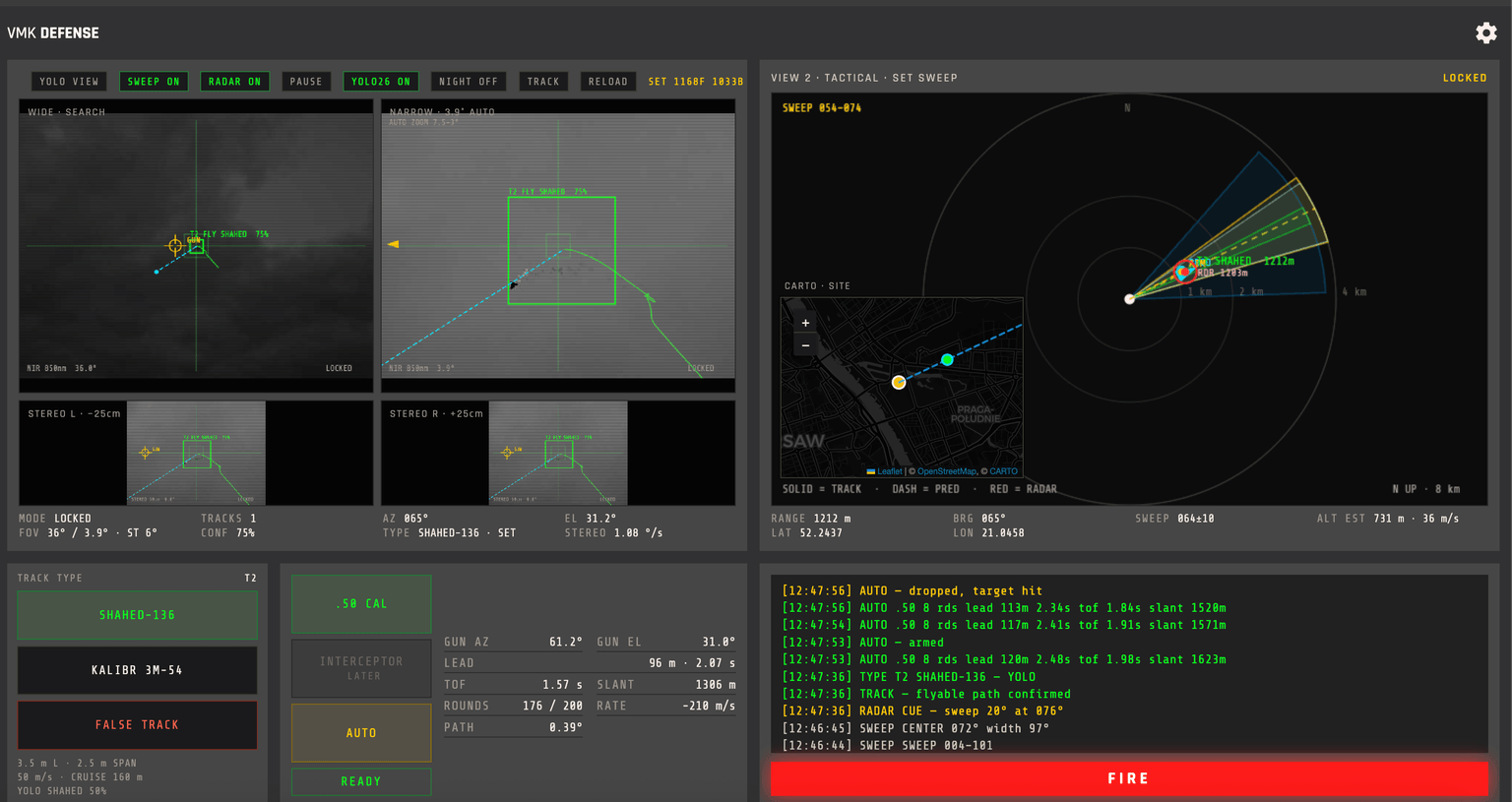 Autofire at intercept: each burst is logged with its lead, time of flight, and slant, taken from the same track the operator sees.
Lead, time of flight, and slant are computed while the object is still well outside the burst. The system holds that solution across a slant of 2–3 km. While the object is closing inside that outer range, autofire is armed and waiting. The track is already a fire solution. The burst has not been spent.
The burst is released at a slant of 1,800 m. By then the predicted path has had the approach to settle, and the object is still inside the envelope the effector can reach. Autofire treats that slant as the best moment for the current site effector: a locked track, range still closing, and a predicted path that agrees with the motion already seen. After the burst the solution is computed again. A further burst waits on a fresh aim.
| Slant | |
|---|---|
| Fire solution held, autofire able to arm while the object closes | 2–3 km |
| Burst released | 1,800 m |
The operator sets the mode and the rules for the sector. A track marked false is not a candidate. Autofire carries the timing inside those rules, which is what makes a sparse set of effectors usable when several threats are in the sky at once: each effector fires for the track in its sector at the slant where that track is ready, and the picture keeps every other track.
What the workstation already runs
The simulated workstation is the loop above, on a single head:
- A three-dimensional flyover generates the threat, the weather, and the camera views.
- The tracker and the fire-control loop see only those views.
- Operator marks, including false tracks, return to the training set.
- A fine-tune reloads into the live detector.
- Autofire arms while the object closes inside the outer slant and releases the burst at 1,800 m.
That single head is already a firing position. Repeating it, across a city or in a belt ahead of one, uses the same interfaces: a track in, a burst out, and a weight file that every head can load.
Related
The product overview, cost, and milestone plan are on the VMK Defense page.