Electro-optical air defense you can afford to field
The cheap aerial threat has already won the cost fight. A one-way attack drone or a low-flying cruise-missile-class airframe costs a fraction of the radar, the missile, and the crew that are supposed to stop it. Defenders keep answering with systems built for a different war: exquisite sensors, scarce interceptors, and sites that cannot be everywhere the threat can fly.
VMK Defense is an optical-electronic air-defense system. A sensor head searches a sector, settles on one object, and holds a track in near-infrared. Fire control shoots from that track. A training loop keeps the vision model current as new airframes appear. It is one pipeline, not three products bolted together, and a site is priced to be repeated.
The sensor head
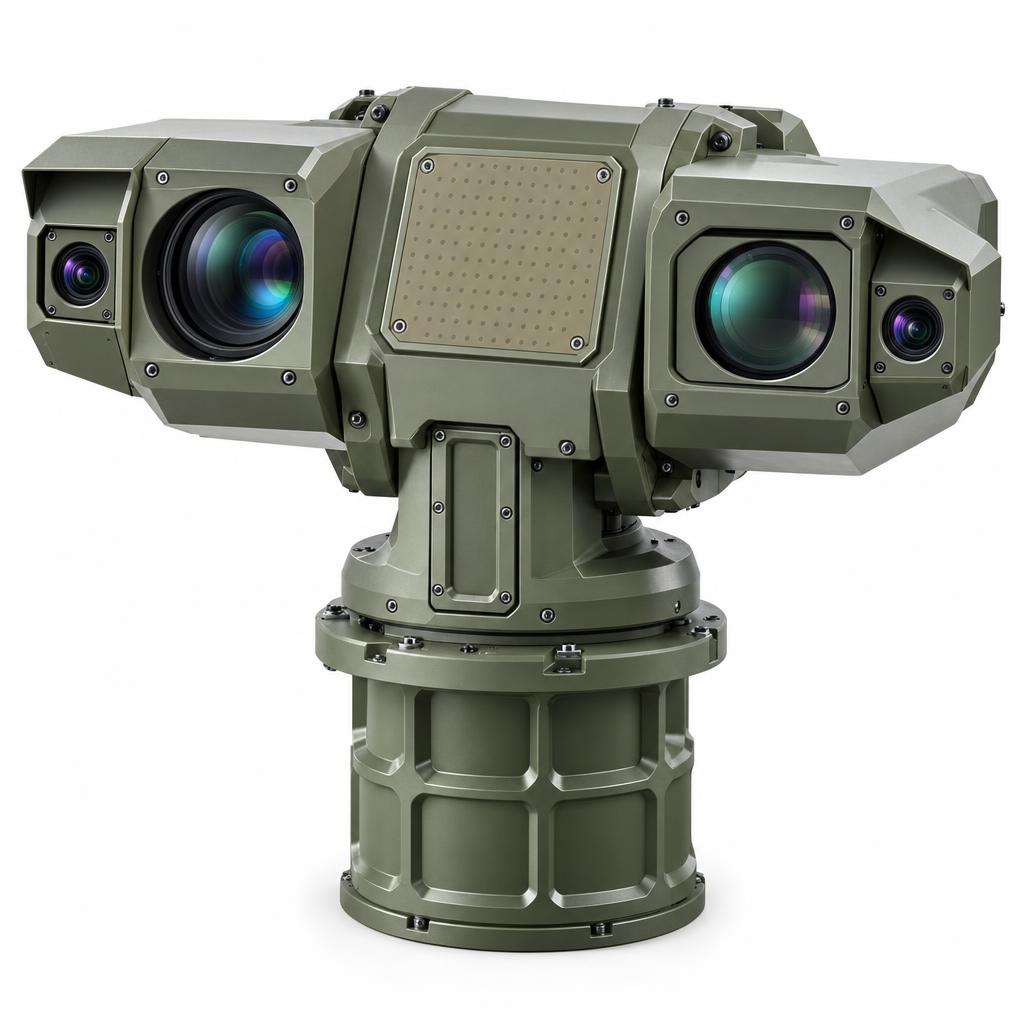 Wide search and narrow follow imagers, with a stereo baseline across the gimbal.
The cameras do the work a wide radar does poorly at short range. A search view covers the sector. A narrow view stays with the object once it is found. A stereo pair gives the track its range. Detection and tracking run on an edge computer beside the mast.
Radar still matters, but it has blind spots operators already live with: ground clutter, low altitude, saturation, and a price that keeps serious coverage on a short list of sites. A small airframe against the sky, even a dark sky, is a visual problem. Night-capable imaging, a search sector, and a tight follow camera can stay with an object that a wide beam only cues.
A track from the picture
The tracker works from imagery alone. It does not start from a reported identity. Search finds a candidate in the sector and a closer look holds it. Detection then confirms that the shape is airborne and of a known type, and the track has to keep agreeing with the motion in the frames. Glare, rooftops, and other still objects are rejected as the track firms up. When it is solid, the operator gets a type. A false track can be marked as one, and that call is kept.
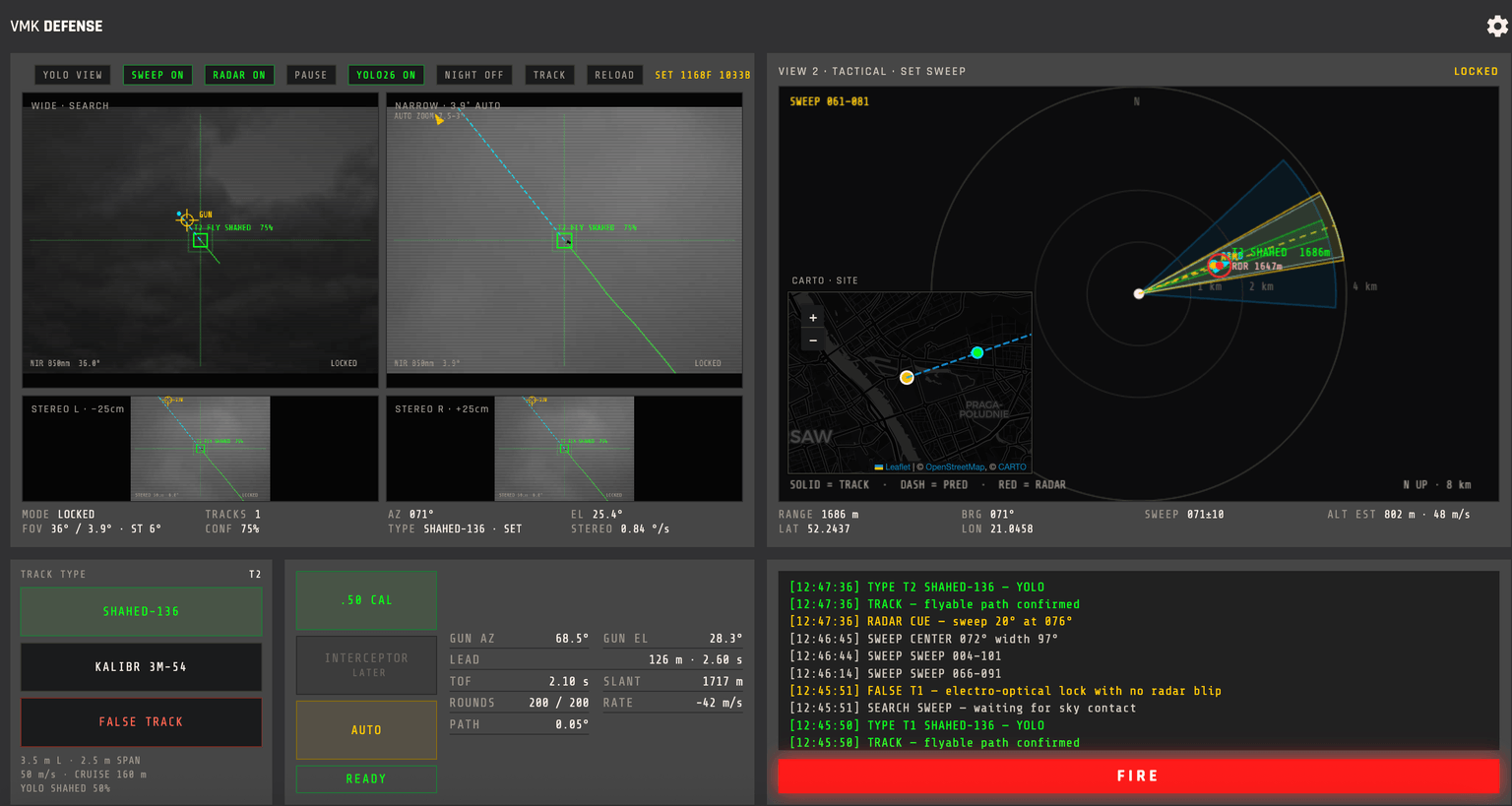 The operator console with a locked track: search and narrow views, the stereo pair, and the sector on a north-up map.
The console stays small: the sector, the feeds, the track state, and the call to fire or discard. A camera that flashes a box on a screen is a demo. A system that moves from search, to a held look, to a track an effector can use is a product. Operators need to know whether the picture is a building, a bird, a glare spike, or something actually flying a path, and they need that answer while the object is still in the defended volume.
One system: tracking, fire control, and training
Tracking, fire control, and training are one system. The optical head produces one track, and fire control fires from that track. The training loop updates the vision model the tracker uses, so a new airframe changes the picture the gun aims from without a second product bolted on beside it.
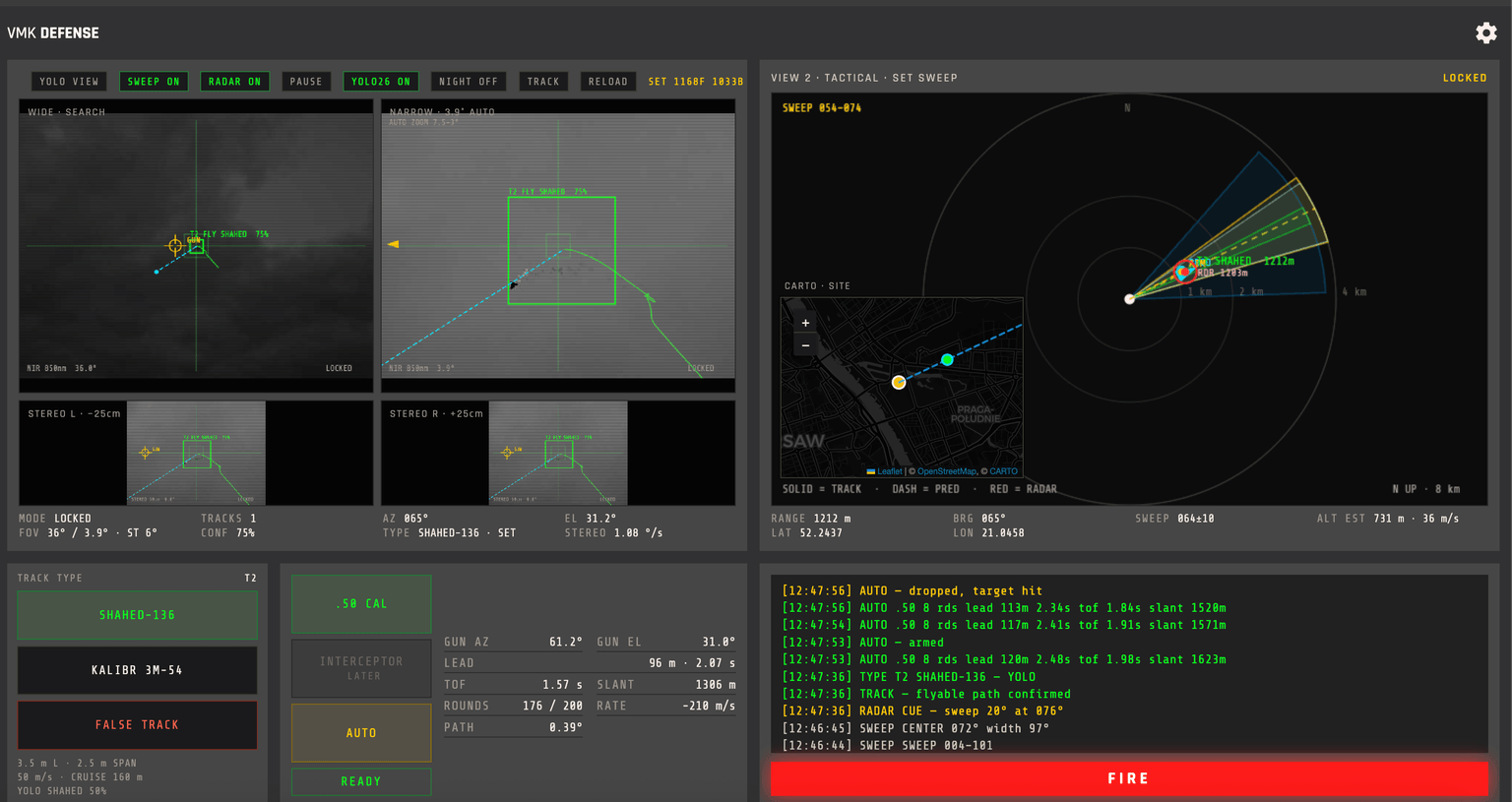 Fire control uses the same track the operator sees: lead, time of flight, and slant range are computed from the optical solution.
The integration is what makes the price real. A camera turret with no fire control still needs a gun and a crew to finish the shot. A gun with no trained detector still needs someone to tell a new silhouette from a roof. Here the track, the burst, and the updated model are one pipeline.
The vision model is the part that has to change
Airframes change faster than sites do: a new shape, a new size, a different exhaust, a different way of crossing the sky. A detector trained on last year's pictures will still see the sky, but it will be slow to recognize the new object for what it is.
Collecting that data from real encounters is the slow way. The useful pictures arrive only after the new system is already flying, in whatever weather, angle, and range the first flights happened to offer. A site that has to wait for a library of real intercepts before it can name the object spends its first engagements half-blind.
Synthetic airframes, then the same model
VMK trains the vision model on synthetic imagery. A new adversary system is built as a visual model and flown through the situations the site will actually meet: noon and night, haze and clear air, overhead passes, low crossings, head-on runs, and cluttered ground under the camera. Every frame is labeled as it is generated. The detector is fine-tuned on that set and reloaded onto the tracker.
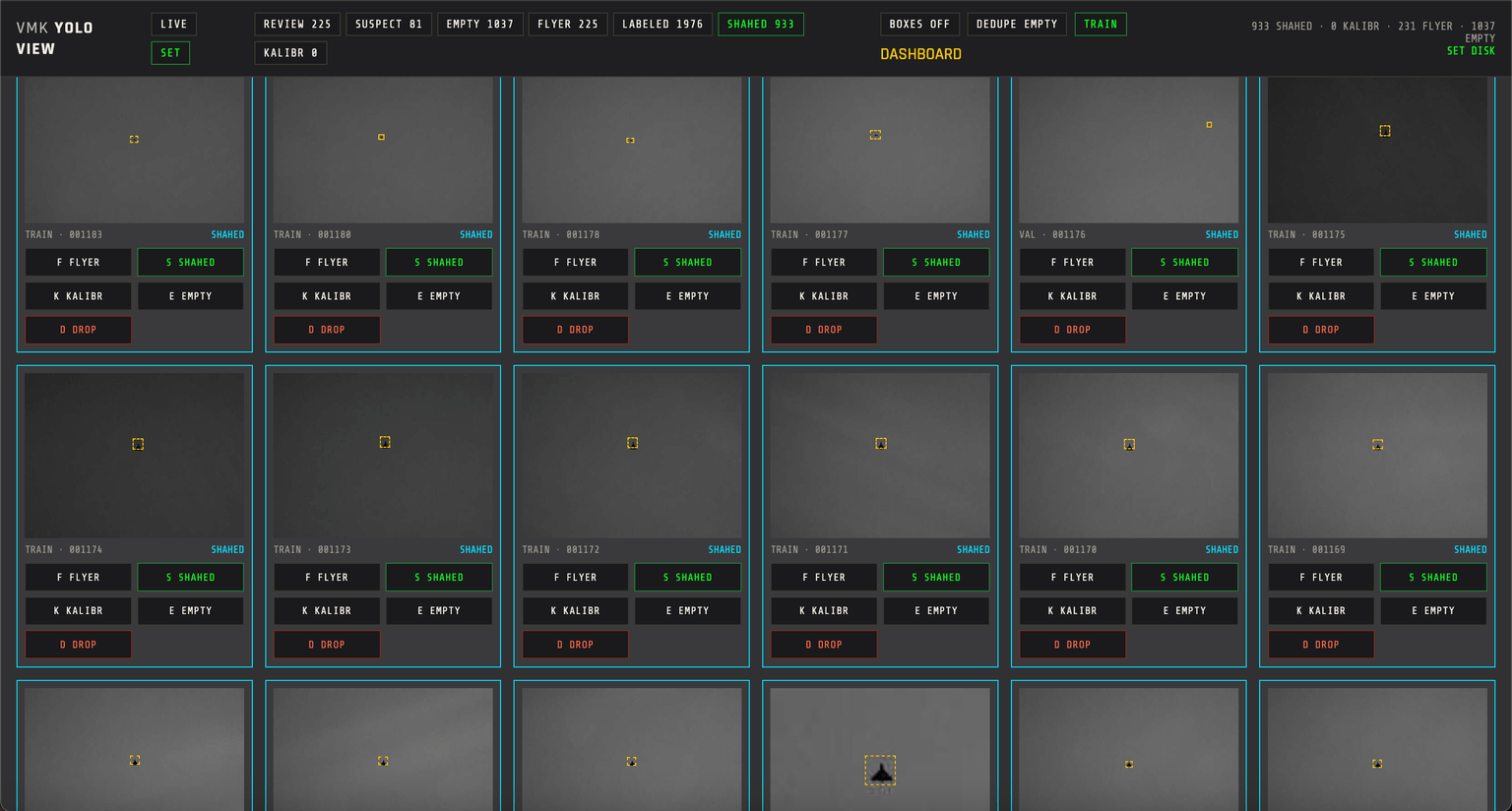 The training view: synthetic near-infrared frames, labeled as they are generated and reviewed before a retrain.
When the adversary fields something new, the response is a new model in the training environment, a retrained detector, and an updated tracker. The optics in the field do not change. The weights do. After a retrain the detector already knows the silhouette across the lighting and flight paths that were synthesized, so the confirmation comes on the first engagements instead of the fiftieth.
Old types stay in the set and new ones are added beside them. False tracks from earlier sessions stay in the training record, so the update learns the new shape without forgetting what the sky and the rooftops look like.
A round that costs less than the drone
A site is a sensor head, a compute box, a .50-caliber effector, and the software that ties them together. Fielded, that package comes in around $100,000, about the price of one of the drones it is meant to stop.
The effector fires a burst of eight rounds. At about $5 a round, one burst is a $40 engagement.
| Interceptor | Shots per intercept | Cost per intercept |
|---|---|---|
| VMK, slow drone (up to ~200 km/h) | usually 1 burst | ~$40 |
| VMK, jet drone (up to ~500 km/h) | 1 to 4 bursts | $40 to $160 |
| Gepard 35 mm gun (~$600 per round) | 6 to 11 rounds | $3,600 to $6,600 |
| Skynex / Skyranger 35 mm AHEAD (~$1,290 per round) | ~10-round burst | ~$13,000 |
| Stinger (MANPADS) | 1 missile | $60,000 to $480,000 |
| IRIS-T SLM | 1 to 2 missiles | $300,000 to $600,000 |
| NASAMS (AIM-120 AMRAAM) | 1 to 2 missiles | $400,000 to $1.2 million |
| Patriot PAC-3 MSE | 1 to 2 missiles | $4 million to $8 million |
Traditional interceptor costs are public estimates and vary by variant and contract. Sources: drone-warfare.com, Defense Express, Ukraine War Analytics, Norsk luftvern, Missile Defense Advocacy Alliance.
A Geran-class drone costs roughly $100,000 to $120,000 to produce, and one site costs about the same. Stopping a single drone of that class spends a burst or two and leaves the system in place for the next one. The attacker has to replace the airframe, while the defender has only spent ammunition. After the first intercept the exchange already favors the defender, and every later pass spends another $40 to $160 against another full drone.
One software stack, scaled to the threat
The hard part of VMK is the software: search, track, classification, fire control, and the training loop. None of it is tied to one camera or one gun. The same stack can drive a larger head with a heavier effector, or shrink into a single compact unit.
That compact unit is aimed at the threat that now dominates the front line: FPV drones. They are cheap, fast, and flown straight at people and vehicles, and there are far too many of them for a crew to call each shot by hand. The design combines the electro-optical sensor and the effector in one turret, firing standard 5.56 mm ammunition. That round is available almost everywhere and costs well under a dollar, and a short burst fits the small, fragile airframe of an FPV drone.
Because the tracker already earns its track from the picture and rejects false tracks on its own, the compact unit can run fully automatically inside a small defended zone, such as a vehicle, a trench line, a command post, or a piece of critical equipment. The operator sets the zone and the rules. The system searches, locks, and fires without waiting for a human to aim.
The scaling works in both directions:
- Compact point defense. Integrated sensor and 5.56 mm effector, fully automatic, protecting a small area against FPV drones.
- Site defense. A separate sensor head and a .50-caliber effector, covering a sector against one-way attack drones and jet-powered drones.
- Shared training. Every unit feeds the same training loop, so a new airframe learned at one site updates the detector across all of them.
What exists today
VMK Defense today is a simulated air-defense workstation. A three-dimensional flyover generates the threat, the weather, and the camera views. A separate operator dashboard sees only the imagery, the way a real camera stack would. It never gets the simulation's answer key. If the software could only track an object because the simulator whispered its identity, it would be useless on a mast.
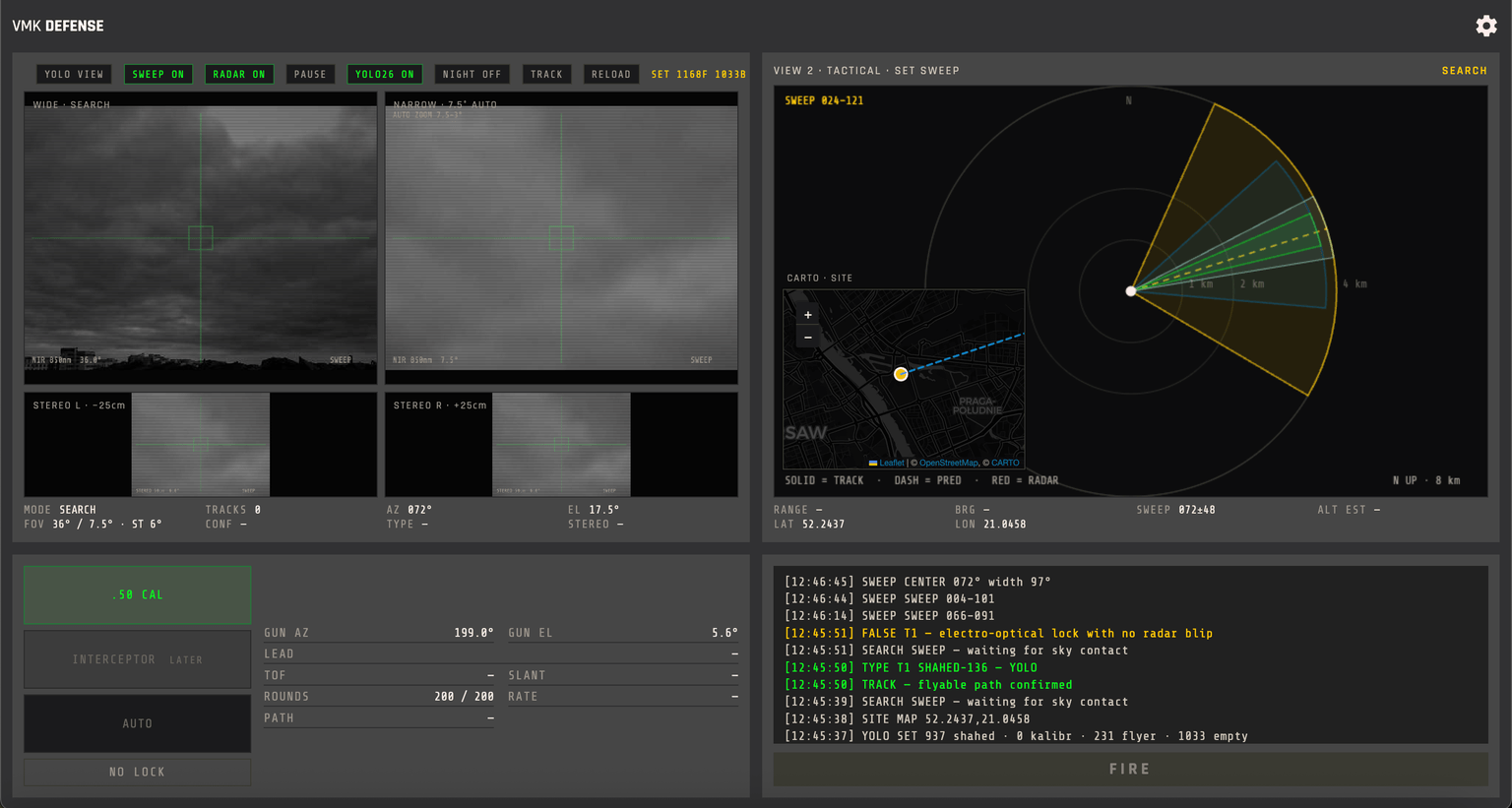 The current workstation: a pixel-only tracker over simulated camera feeds, with the operator's calls feeding back into training.
The operator slews the sector, watches the track mature, and marks what the picture actually was. Those marks become training data. The detector is fine-tuned on the scenarios that were just flown, then loaded back into the live loop.
Optics, gimbals, and interceptors are slow and expensive to get wrong. A pixel-only tracker, a labeling loop, and a site model let us break the software against clutter, night, crossing paths, and false tracks before a lens is purchased.
What's next
The next step is to take the same loop off the screen and onto a mast:
- Sensor and gimbal. Real near-infrared cameras, a stabilized head, and the mechanical path from a sector sweep to a settled stare.
- Edge compute. The track has to run beside the mast, in the weather, without a lab GPU on a desk.
- Effector integration. One intercept path, proven against the track the optics actually produce, on an instrumented range.
- Trials and data. Night, clutter, low altitude, and crossing paths. Every hour on the range feeds the same training loop the simulation already uses.
- The compact counter-FPV unit. Sensor and 5.56 mm effector in one turret, running the same software in fully automatic mode.
- The production console. The operator interface, hardened and simplified for a crew that did not write it.
The first milestone is a locked track on a real object, from real cameras, with a measured handoff to the effector. The second is a repeatable intercept on a range. The third is a site drawing a customer can price.
Get in touch
If you fund air defense, sensors, or defense manufacturing, or you are a defense partner looking at short-range counter-drone coverage, contact us for a briefing on the milestone plan. We will show the workstation running.